


- By h3si5
- September 3, 2026
- 0 Comment
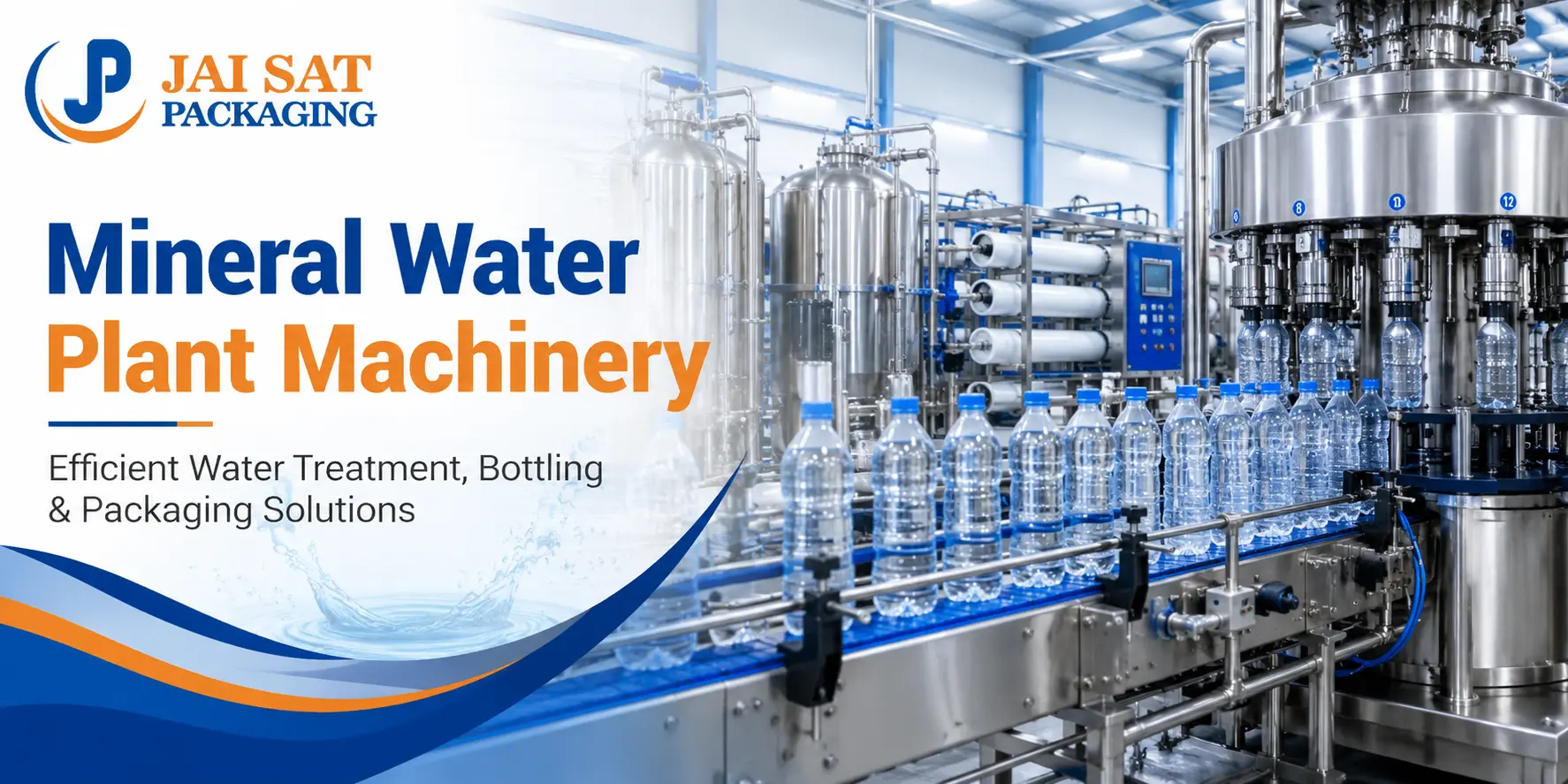
Mineral Water Plant Machinery for automatic water bottling and packaging by Jai Sat Packaging
Mineral Water Plant Machinery: Building an Efficient Water Bottling Business
The packaged drinking water industry continues to grow as consumers, offices, hotels, hospitals, restaurants and retailers seek hygienically processed water. For entrepreneurs planning a new facility or upgrading an existing operation, selecting reliable Mineral Water Plant Machinery is one of the most important decisions for building an efficient and consistent water bottling business.
A water bottling plant involves several connected stages. Water may require storage, filtration, reverse osmosis, disinfection, filling, capping, labelling and secondary packaging before it is ready for distribution.
Equipment must work together efficiently to support consistent production, hygiene and manageable operating costs. Jai Sat Packaging provides machinery solutions for businesses planning water bottling and packaging operations.
What Is Mineral Water Plant Machinery?
Mineral Water Plant Machinery refers to the combination of water-treatment and packaging equipment used to process drinking water and fill it into bottles, jars or other containers. Depending on the plant design, equipment can include raw-water storage tanks, sand filters, activated carbon filters, RO systems, UV sterilizers, ozone systems, treated-water tanks, rinsing machines, filling and capping machines, labelling equipment and shrink-packaging systems.
The configuration depends on production capacity, bottle sizes, automation, space, source-water characteristics and expansion plans. A smaller operation may require semi-automatic equipment, while a larger commercial facility may benefit from an integrated automatic line.
Major Stages of a Water Bottling Plant
Raw Water Storage
Production generally begins with raw water stored in a suitable tank. Storage capacity should be planned around the required production rate and operating schedule so the treatment section receives a dependable supply.
Filtration
Sand filtration can help remove suspended particles and reduce turbidity before water reaches finer treatment stages. Activated carbon filtration may help reduce certain odours, colours, chlorine and organic contaminants where applicable. Regular monitoring and maintenance are important.
Reverse Osmosis
Reverse osmosis, commonly called RO, uses specialized membranes to separate many dissolved impurities from the treated water stream.
The appropriate RO capacity depends on incoming water quality, recovery rate and desired production output. When selecting Mineral Water Plant Machinery, the RO system should be properly matched to the overall bottling capacity.
UV and Ozone Treatment
UV treatment uses ultraviolet light as part of the disinfection process. Ozone treatment may also be included as an additional disinfection stage. The treatment sequence should be designed according to source-water characteristics and applicable quality requirements.
Bottle Rinsing, Filling and Capping
After purification, water moves into the packaging section. Modern Mineral Water Plant Machinery can integrate bottle rinsing, filling and capping in a coordinated system. Empty containers are rinsed, transferred to the filling station, filled to a controlled level and capped.
When selecting filling equipment, businesses should consider container sizes, required bottles-per-hour output, cap type and changeover requirements. Planning for future packaging formats can make the production line more adaptable.
Labelling and Secondary Packaging
After filling and capping, bottles can pass through labelling equipment. Consistent label placement creates a uniform appearance and provides space for required package information. Secondary packaging may include shrink wrapping, bundle packaging or carton-based packing depending on the distribution model.
Integrating these stages with the bottling line can help create a smoother flow from treatment to dispatch-ready products and reduce unnecessary manual handling.
Automatic vs Semi-Automatic Systems
Automation level should match the business’s actual production needs. Semi-automatic systems may suit moderate production requirements or businesses with limited initial investment. Operators may perform selected loading, handling or packaging tasks while machinery completes important processing operations.
Automatic lines connect multiple stages with reduced manual intervention and can support higher throughput and consistency when correctly configured and maintained. Automatic systems require greater investment, suitable utilities, trained operators and planned maintenance.
The best Mineral Water Plant Machinery is therefore not necessarily the largest available system. It should match current production goals and realistic expansion plans.
Factors to Consider Before Buying
Before purchasing equipment, buyers should evaluate several practical factors:
- Production Capacity: Match hourly output to demand.
- Raw Water Quality: Test incoming water before selecting treatment equipment.
- Bottle Sizes: Identify every container format.
- Automation: Choose manual, semi-automatic or automatic operation.
- Space and Utilities: Plan treatment, packaging, storage, electricity and water requirements.
- Maintenance and Expansion: Review service needs, spare parts and future growth.
A detailed requirement assessment before ordering the equipment can help prevent capacity mismatches and unnecessary expenses.
Benefits of an Integrated Production Line
An integrated water bottling line allows treatment, filling, capping and packaging sections to operate as a coordinated system. Properly matched capacities can reduce bottlenecks and support smoother material movement.
A well-planned line may provide more consistent filling, reduced manual handling, better use of floor space and easier production planning. Automation can also support repeatable operating procedures. Even automated machinery requires trained staff, monitoring and preventive maintenance.
Investing in appropriately selected Mineral Water Plant Machinery can provide a structured foundation for businesses entering the packaged drinking water sector or expanding an existing facility.
Why Choose Jai Sat Packaging?
Jai Sat Packaging offers machinery solutions for water bottling and packaging projects. Customers can discuss production capacity, bottle formats, automation preferences, available factory space and plant layout before selecting suitable equipment.
Businesses should consider how each unit connects with the next production stage. A balanced line helps prevent one section from unnecessarily restricting the output of another. For Mineral Water Plant Machinery requirements, a clear discussion of water characteristics, output targets and packaging formats can make equipment selection more practical.
Maintenance for Reliable Performance
Regular maintenance is essential. Filters should be inspected and replaced as required, RO membranes need monitoring, moving parts may require lubrication, and filling components should be cleaned according to recommended procedures.
Operators should maintain equipment records and monitor relevant production parameters such as pressure, flow rate and filling accuracy. Tanks, pipelines, filling sections and contact surfazes should also be maintained according to applicable hygiene practices.
Routine care of Mineral Water Plant Machinery can help reduce unexpected downtime, support equipment life and maintain consistent production.
Conclusion
Building a successful packaged-water operation requires planning across purification, bottle handling, filling, capping, labelling and final packaging. Choosing suitable Mineral Water Plant Machinery is therefore a long-term operational decision rather than simply a machine purchaze.
Production capacity, raw-water characteristics, automation level, available space, maintenance requirements, container formats and future expansion should all be considered before finalizing a plant. Jai Sat Packaging can support businesses seeking machinery solutions based on their water bottling and packaging requirements.
