

-
By Jai sat packaging
-
November 26, 2026
- 0 Comment
Air Conveyor vs Belt Conveyor for Empty Bottles: Which Is Right for Your Line?
Air vs Belt Conveyors for Empty PET Bottles: Speed and Setup Compared
Choosing a conveyor looks simple until the line starts running. Empty PET bottles are very light, so the wrong choice causes tipped bottles, jams and unplanned stops. This guide explains Air Conveyor vs Belt Conveyor For Empty Bottles in plain words, so you can pick the right option for your plant. We also show where each type fits in a bottling line.
How Each Conveyor Moves Bottles
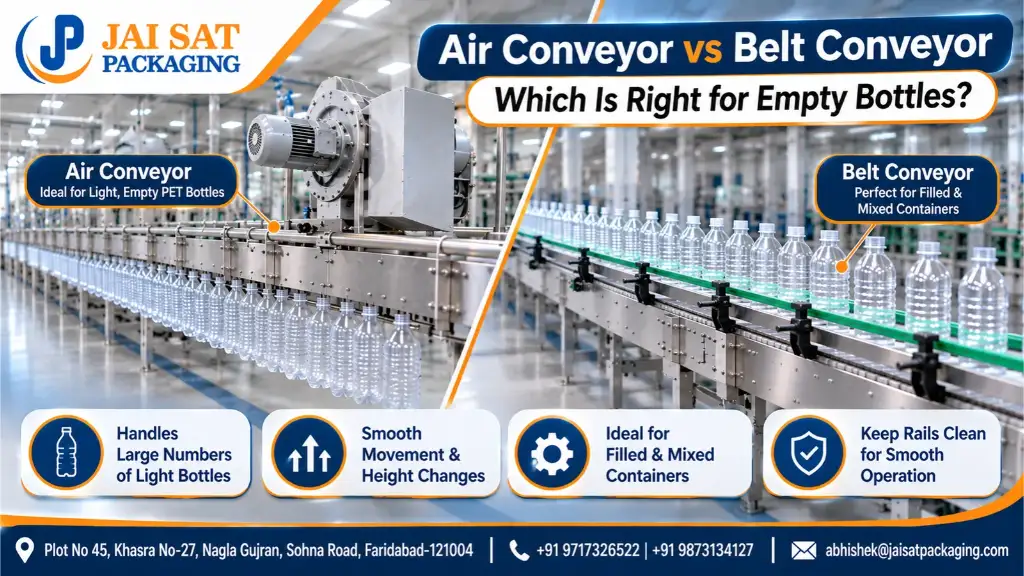
An Air Conveyor hangs empty PET bottles by the neck ring on two guide rails. Blowers push air through small openings, and the bottles glide along the rails. Nothing touches the bottle except the rails at the neck.
A belt conveyor carries bottles standing on a moving belt. The belt pulls the bottles forward and they ride on top. This design is familiar, works with many container shapes and can also carry filled bottles.
Air Conveyor vs Belt Conveyor for Empty Bottles: Quick Comparison
| Factor | Air conveyor | Belt conveyor |
|---|---|---|
| Best for | Empty PET bottles with a neck ring | Many container types, empty or filled |
| Contact with bottle | Neck only | Whole base |
| Stability | Bottles hang, so they rarely tip | Light bottles can tip on bends |
| Routing | Easy to go up, down and around | Needs more floor space |
| Moving parts | Few (blower and rails) | Belt, rollers, drive, bearings |
| Cleaning | Keep rails and air clean | More surfaces to clean |
| Filled bottles | Not suitable | Suitable |
| Size changeover | Rail width must match the neck | Side guides adjust to bottle size |
| Usual position | Before the rinser and filler | After the capper |
Where Air Conveyors Work Best
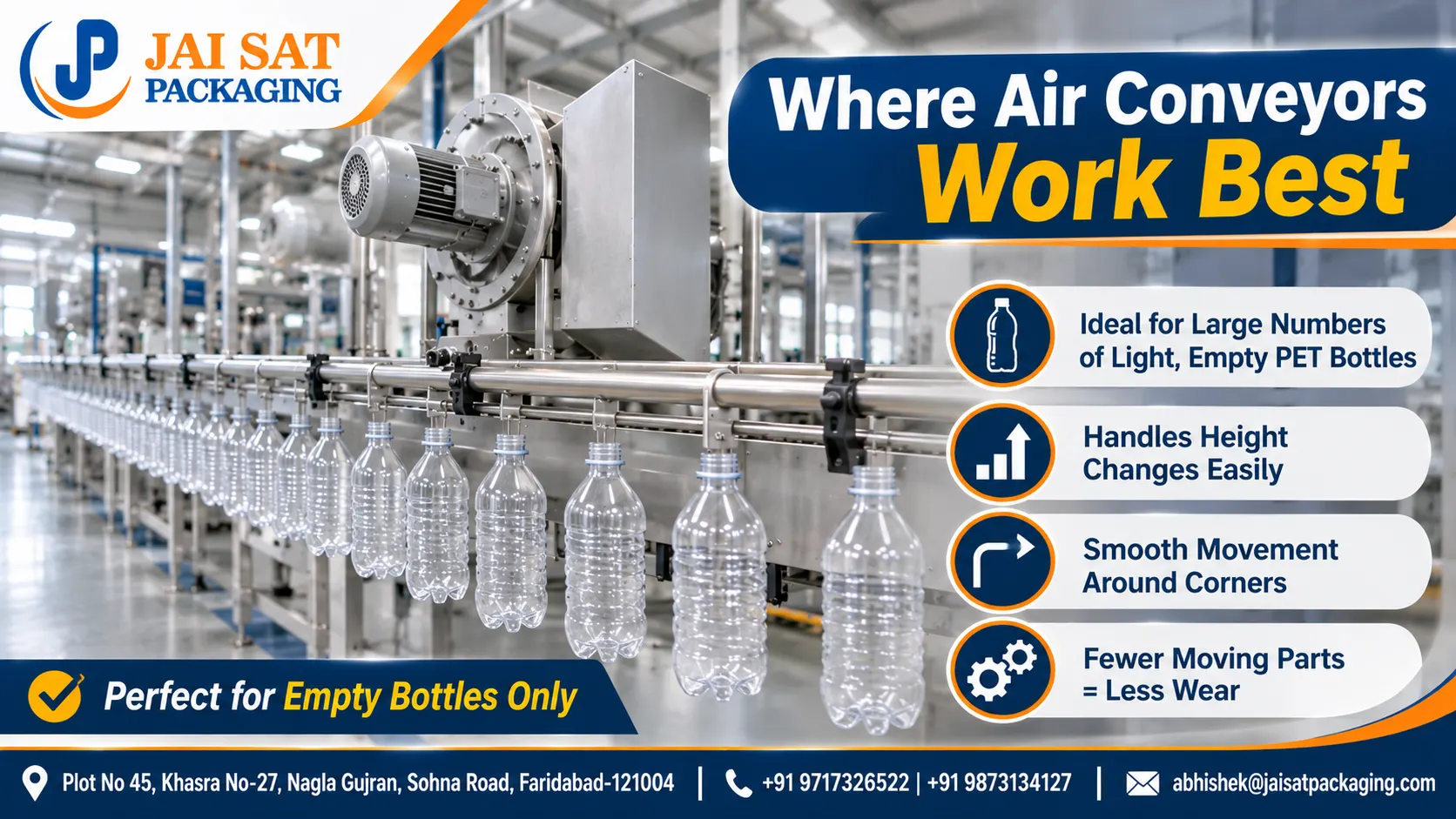
Air conveyors suit lines that move large numbers of light, empty PET bottles. Because the bottle hangs by its neck, it cannot fall over, and there is little friction. That helps when bottles travel from the bottle supply to the rinsing, filling and capping machine.
They also handle height changes well. A line can climb over a walkway or turn a corner without much floor area, and fewer moving parts mean less wear.
There are limits. The bottle needs a proper neck ring, and the rails must match the neck size. Dust in the air can enter the bottles, so keep the area clean and use good filtration. Finally, an air conveyor is for empty bottles only.
Where Belt Conveyors Work Best
Belt conveyors are the better choice when your line handles mixed containers, such as jars, cans or glass bottles. They are also the usual answer once bottles are filled and capped, because a full bottle is heavy, stable and cannot hang from its neck.
Belts work well for short, straight runs and packing tables. The trade-off is more moving parts, more cleaning and more floor space. Very light empty bottles can also tip on belt corners.
For filled bottles and packs, our Slat chain conveyors are built for this kind of work, moving bottles to labelling, cooling and packing.
Cleaning and Upkeep
Both types need regular care. For air conveyors, keep the rails smooth, check that air openings are not blocked and replace blower filters on schedule. For belt conveyors, inspect the belt for wear and check tracking so it does not drift. A written weekly checklist avoids surprise stops.
Mistakes to Avoid
Teams weighing Air Conveyor vs Belt Conveyor For Empty Bottles often repeat the same errors:
- Treating every bottle the same. Neck ring, weight and shape change which conveyor will run smoothly.
- Using an air conveyor for filled bottles. It is designed for empties.
- Ignoring the layout. Measure the route, the height difference and the turns first.
- Choosing only on price. A cheap setup that jams often costs more in lost output.
- Skipping a trial. Test with your own bottle samples before you decide.
How to Choose: Simple Buying Advice
Use these six checks to settle Air Conveyor vs Belt Conveyor For Empty Bottles for your own plant.
- Know your bottle. Note the size, weight, material and neck ring design.
- Know your speed. Write down current output and what you plan in two years.
- Map the route. Check distance, height and turns between machines.
- Check the environment. Ask how dust, humidity and cleaning will be handled.
- Ask for a trial. See your sample bottle running on the proposed conveyor.
- Compare what is included. Confirm blowers, rails, supports, installation, training and spare parts in writing.
A Smart Setup for a PET Bottling Line
In practice, Air Conveyor vs Belt Conveyor For Empty Bottles is not always an either-or choice. A common layout uses an air conveyor to move empty bottles into the rinsing, filling and capping machine. After capping, filled bottles move on a slat chain or belt conveyor to the BOPP roll feed labeller, the cooling tunnel and the packing area.
Planning these parts together prevents speed mismatches at transfer points. For a full plant, read our guide on choosing a beverage processing plant manufacturer in India, and see our BOPP labeling machine price guide for the labelling stage.
Conclusion
The right answer to Air Conveyor vs Belt Conveyor For Empty Bottles depends on your bottle, your speed and your layout. Air conveyors suit light PET empties and flexible routes, while belt or slat chain conveyors suit filled bottles and mixed containers. Many plants use both. To find the right fit, contact Jai Sat Packaging with your bottle samples and target output, or explore our Products.
FAQ's
Can an air conveyor move filled bottles?
No. It hangs bottles by the neck and is meant for light, empty bottles. Use a slat chain or belt conveyor after filling.
Which is cheaper, an air conveyor or a belt conveyor?
It depends on route length, layout and speed. Compare the complete project cost, including spares and cleaning, instead of the base price only.
Do I need a different conveyor for each bottle size?
Air conveyor rails are set for the neck size, so a change may need adjustment. Belt conveyors usually adjust side guides. Share your bottle range with the supplier.